
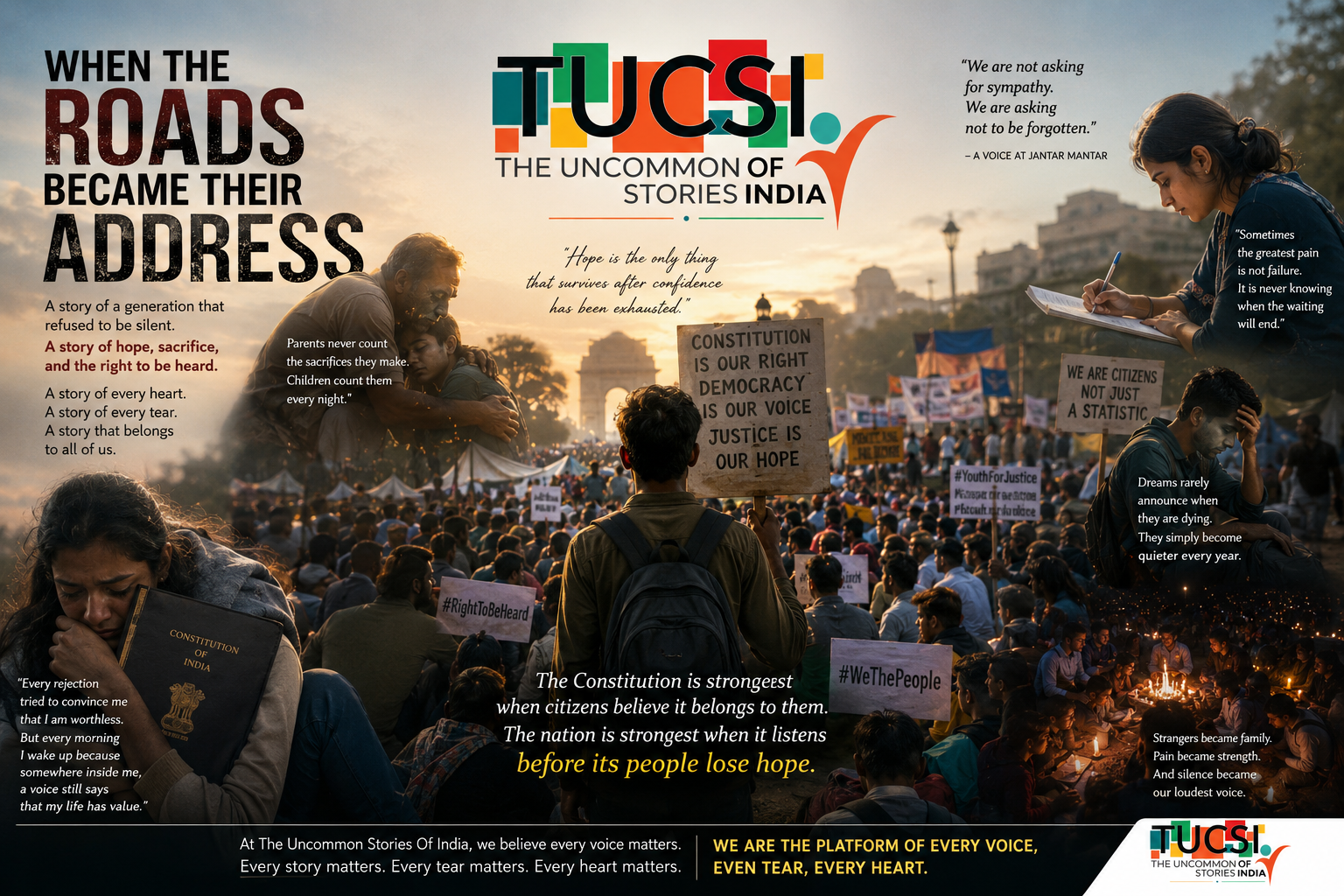
“Every Constitution is tested not only inside courtrooms, but also on the streets where ordinary citizens wait to be heard.”
The Story Written By Rahat Ali
When the Roads Became Their Address
“Every Constitution is tested not only inside courtrooms, but also on the streets where ordinary citizens wait to be heard.” Said By Rahat Ali
There are stories that never become breaking news. There are tears that never reach television screens. There are dreams that quietly disappear before anyone notices they ever existed. Across India, countless young people have stood on roads, in public squares, and at democratic protest sites, carrying nothing more dangerous than hope and nothing heavier than years of waiting. This is a fictional story inspired by that collective experience. It is not the story of one individual, one organisation, or one protest. It is the story of every generation that has ever stood peacefully to seek what it believes are its constitutional rights. It is the story of those who left behind families, careers, comfort, and certainty to stand together in hope. It is the story of every tear that fell unnoticed and every heartbeat that refused to surrender. At The Uncommon Stories Of India, we believe that every voice deserves to be remembered, every silence deserves to be understood, and every tear deserves to become part of history.
“Some people inherit wealth. Some inherit power. This generation inherited waiting.”
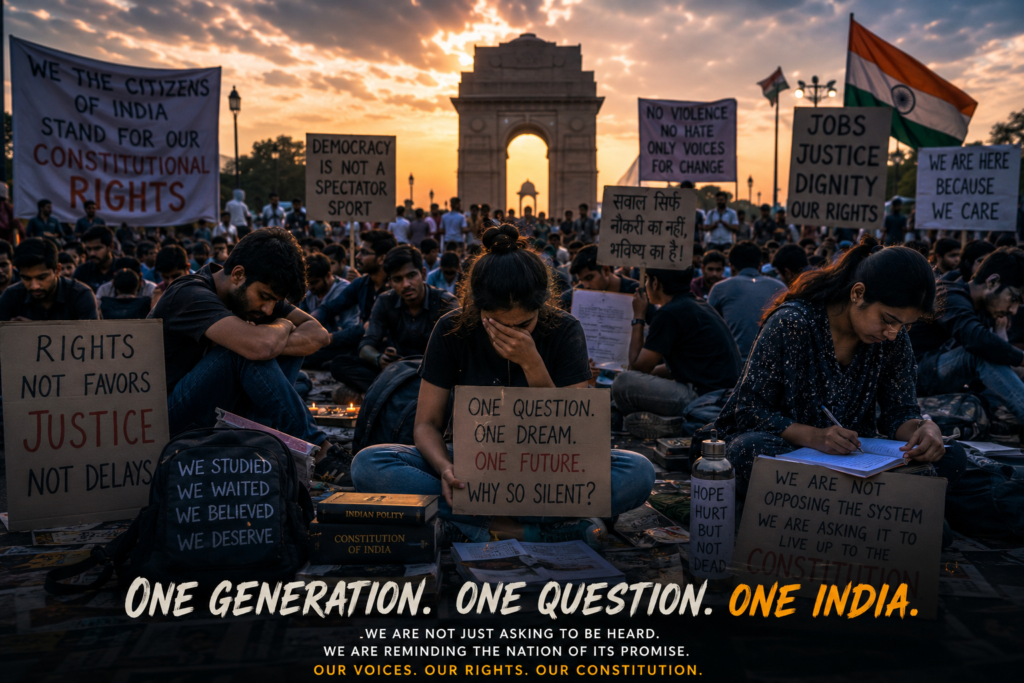
The morning sun rose over Delhi, and the roads leading to Jantar Mantar slowly filled with young faces from every corner of India. They spoke different languages, followed different faiths, belonged to different communities, and carried different demands, yet they all shared the same expression—a silent question that no one had answered for years. Some carried folders filled with certificates. Others carried worn-out backpacks containing clothes, medicines, and copies of the Constitution. A few held placards. Many carried only hope. Every face had a story that no newspaper headline could ever fully explain.
“The hardest journey is not from home to Delhi. The hardest journey is from hope to uncertainty.”
Among the gathering stood Aarav, a fictional young graduate whose degree once filled his parents with pride. Years earlier, when he graduated, neighbours congratulated his family and predicted a bright future. His mother proudly framed his photograph and placed it in the living room. She believed that one day officers, teachers, and respected people would visit her house to congratulate her son. The frame still hung on the wall. Only the dream inside it had begun to fade. Every month she dusted the frame, but she could not wipe away the sadness growing inside her son’s eyes.
“A certificate can prove education, but it cannot guarantee dignity.”
Standing beside him was Meher, another fictional character who had dreamed of becoming a government teacher. She knew every article of the Constitution she had studied, every examination rule, every recruitment notification, every postponement, every delay, and every court hearing related to the process she had dedicated years of her life to. Her notebooks were no longer filled with lesson plans for children. They were filled with dates—exam dates, cancellation dates, hearing dates, and the endless calendar of uncertainty. Every page reminded her that time moves forward even when dreams stand still.
“Sometimes the greatest pain is not failure. It is never knowing when the waiting will end.”
Kabir had sold his motorcycle to pay coaching fees. Then he sold his laptop to afford another examination form. Gradually he stopped buying new clothes. Birthdays disappeared from his calendar. Festivals became ordinary days because every rupee meant another application, another journey, another examination centre, another chance. He never complained to his parents because he knew they had already sacrificed enough. His father had quietly postponed medical treatment so that his son could continue preparing. His mother often skipped buying medicines she needed because she believed her son’s future mattered more than her own comfort.
“Parents never count the sacrifices they make. Children count them every night.”
Every afternoon, elderly parents travelled long distances carrying homemade food for their sons and daughters sitting peacefully on the roadside. Some parents fully understood the legal issues their children were protesting about. Many did not. But every parent understood hunger, exhaustion, and disappointment. They opened lunch boxes with trembling hands, smiled through watery eyes, and quietly asked the same question every day: “Have you eaten?” Behind that simple question hid hundreds of others they were too afraid to ask.
“No parent dreams of seeing their child grow old while waiting for a future.”
The roads of Delhi became more than roads. They became classrooms where democracy was studied through experience instead of textbooks. They became waiting rooms where hope was tested every sunrise. They became temporary homes where strangers became family. The pavement became a pillow. A backpack became a cupboard. A water bottle became a luxury. Every evening, the same roads witnessed conversations about dreams, fear, unemployment, dignity, justice, and survival. They also witnessed silence—because some emotions cannot be translated into words.
“The road does not ask your religion, caste, language, or state. It only knows the weight of your footsteps.”
Far away, across India, mothers waited beside their phones. Fathers switched on news channels hoping to recognise familiar faces among the crowd. Younger siblings proudly shared old photographs while secretly worrying about the future. Grandparents prayed quietly, asking only that their children return home safely. Every family lived two lives at once—one inside their house and another on the streets where someone they loved continued waiting for tomorrow.
“Every protest has two locations—the street where people stand and the home where families silently wait.”
As the days passed, the heat became unbearable. Then came rain. Banners became soaked. Clothes remained wet for hours. Important documents had to be wrapped inside plastic bags to protect years of hard work from disappearing in a single storm. Degrees, certificates, admit cards, identity proofs, and handwritten notes were guarded more carefully than personal belongings because they represented years of sacrifice. A young woman joked that perhaps the rain could wash away disappointment. Nobody laughed because everyone knew disappointment does not dissolve in water.
“Rain can erase ink, but it cannot erase sacrifice.”
One evening, a journalist approached a young protester and asked what message he wanted to give the country. The young man looked around at exhausted friends sitting on the pavement, parents distributing food, students revising books under streetlights, volunteers helping strangers, and elderly citizens silently offering encouragement. After a long pause he answered softly, “We are not asking anyone to feel sorry for us. We are asking not to be forgotten.” The journalist lowered the microphone because sometimes the shortest answers carry the deepest truths.
“The greatest fear is not rejection. The greatest fear is becoming invisible.”
Late at night, when the crowds became smaller and the noise faded away, the conversations became painfully honest. Some admitted they had begun doubting themselves. Others confessed they had stopped attending family functions because they were tired of hearing the same question: “When will you finally settle?” Some quietly admitted that they no longer recognised the person they had once dreamed of becoming. Yet every sunrise found them standing together once again because somewhere inside every broken heart remained one stubborn belief—that tomorrow might finally be different.
“Hope is the only thing that survives after confidence has been exhausted.”
One night Kabir looked toward the empty road and whispered to Aarav, “Do you ever feel worthless?” Aarav remained silent for a long time before replying, “Every rejection tried to convince me that I am worthless. But every morning I wake up because somewhere inside me a voice still says that my life has value.” Neither of them cried openly. They simply looked toward the sky together, carrying the weight of years inside a single moment of silence.
“The strongest people are often those who continue standing after life has given them every reason to sit down.”
Children visiting Delhi with their schools passed by the gathering and innocently asked their teachers who these people were. One teacher simply replied, “They are citizens.” A child then asked, “What are they doing?” The teacher answered, “They are asking to be heard.” The child looked puzzled and quietly asked, “Doesn’t everyone get heard?” The teacher had no answer. Sometimes children ask questions that entire societies struggle to answer.
“The innocence of a child often exposes the unanswered questions of a nation.”
Months later, people slowly began returning home. Some eventually found new careers. Some continued preparing. Some started small businesses. Some changed their dreams entirely. Some never fully recovered from the emotional weight of waiting. But everyone carried something back that could never be measured by certificates or salaries—the understanding that dignity matters, peaceful voices matter, democratic participation matters, and every citizen deserves to believe that their concerns can be heard.
“History does not remember only those who win. It also remembers those who refused to stop believing.”
Years later, if someone were to ask what remained on those roads after the crowds disappeared, the answer would not be banners or footprints. What remained were invisible memories—the dreams that refused to die, the tears that strengthened strangers, the parents who never stopped believing in their children, and a generation that learned that constitutional values are not merely words printed on paper but ideals that citizens continue to discuss, question, and uphold through peaceful participation.
“Nations become stronger when they listen before their people lose hope.”
At The Uncommon Stories Of India, we do not believe that only famous people deserve to have their stories told. We believe that every citizen who carries hope through pain, every parent who silently sacrifices for a child, every young person who refuses to surrender dignity, and every peaceful voice that chooses dialogue over despair deserves a place in history. We believe that every tear has meaning, every heartbeat carries a story, and every ordinary citizen has the power to remind a nation that democracy is strongest when every voice matters.
“The roads never asked who they were. They simply carried them. One day, may history carry their stories with the same compassion.”


2 comments
Chandra Paul
Every story matters, and this is an important reminder of justice, dignity, and humanity. Well done, TUCSI❤️
TucsiAuthor
Yes, You Are Right