

Written By Rahat Ali
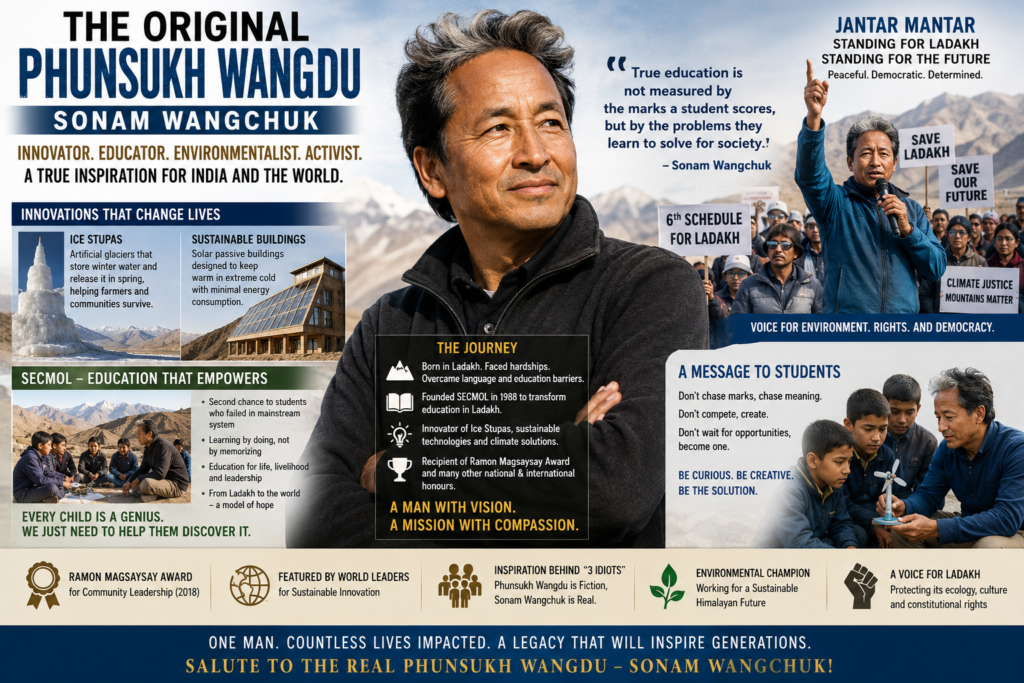
“True education is not measured by the marks a student scores, but by the problems they learn to solve for society.” Said By Rahat

There are few individuals whose lives become larger than the stories written about them. Sonam Wangchuk is one such personality. While millions across the world recognize the fictional character Phunsukh Wangdu from the blockbuster film 3 Idiots, only a few truly understand the remarkable journey of the man who inspired that unforgettable role. Yet, Sonam Wangchuk’s real-life story extends far beyond cinema. It is a story of resilience born in the cold deserts of Ladakh, of innovation developed through necessity, and of a relentless commitment to ensuring that education serves humanity rather than merely producing degrees. His life demonstrates that genuine success is measured not by fame or wealth but by the positive impact one leaves on society.Born in the remote Himalayan region of Ladakh, Sonam Wangchuk grew up in an environment where survival demanded creativity and resilience. The geographical isolation of the region meant limited access to educational institutions, healthcare, communication, and modern infrastructure. During his childhood, formal education was not easily accessible. Like many children from remote Himalayan villages, he initially struggled because the school system functioned in languages unfamiliar to him.
Instead of nurturing curiosity, conventional education often alienated rural students from their own culture and surroundings. These early struggles became the foundation of his lifelong mission to transform education into a system that respects local realities while preparing students for global challenges.Unlike many innovators who emerge from privileged backgrounds equipped with advanced laboratories and financial resources, Wangchuk’s classroom was nature itself. The harsh climate of Ladakh became his teacher, while the challenges faced by ordinary people became his research topics. Rather than viewing adversity as an obstacle, he learned to see it as an opportunity to innovate. This mindset would later become the defining feature of his work.
Determined to improve educational opportunities for young people, Wangchuk co-founded the Students’ Educational and Cultural Movement of Ladakh (SECMOL). The initiative emerged from a disturbing reality: a significant number of Ladakhi students were repeatedly failing in conventional school examinations, not because they lacked intelligence but because the education system failed to understand their context. Instead of blaming students, Wangchuk questioned the system itself.
He believed education should encourage problem-solving, creativity, critical thinking, and practical skills rather than memorization.
SECMOL gradually evolved into one of India’s most inspiring educational experiments. Students who had been labeled academic failures found a second chance to discover their abilities. They learned not only mathematics and science but also leadership, engineering, environmental sustainability, farming, entrepreneurship, and community responsibility.
Education was no longer confined to textbooks. Every building became a laboratory, every solar panel a science lesson, and every farming activity a practical classroom. Students learned by doing rather than by memorizing. The transformation demonstrated that when education respects local knowledge and encourages innovation, even those once considered failures can become remarkable achievers.
The philosophy behind SECMOL attracted national and international attention because it challenged one of the biggest misconceptions in education—that examination scores alone determine intelligence. Wangchuk consistently emphasized that every child possesses unique strengths and that society loses enormous potential when education rewards only rote learning. His work inspired educators across India to rethink classroom practices and student assessment.
One of Wangchuk’s greatest contributions has been his commitment to sustainable innovation. Living in one of the world’s coldest inhabited regions, he understood the severe challenges posed by water scarcity, freezing temperatures, and climate change. Instead of depending entirely on expensive technological imports, he developed practical, locally relevant solutions.
Among his most celebrated innovations is the Ice Stupa project. During winter, excess stream water is frozen into towering cone-shaped ice structures that gradually melt during spring, providing water for agriculture when farmers need it most. The innovation combines traditional understanding with scientific principles, creating an elegant response to climate-induced water shortages. The Ice Stupa became an internationally recognized example of climate adaptation, demonstrating that simple ideas rooted in local realities can address global environmental challenges.
His work also extended to designing energy-efficient buildings capable of maintaining comfortable temperatures even during severe winters without excessive dependence on fossil fuels. These structures use passive solar heating techniques, reducing both energy costs and environmental impact. Such innovations illustrate Wangchuk’s belief that sustainable development must emerge from harmony between human needs and nature rather than exploitation of natural resources.
The world gradually began to recognize the significance of his contributions. Wangchuk received numerous national and international honours, including the prestigious Ramon Magsaysay Award, often regarded as Asia’s equivalent of the Nobel Prize.
Recognition came not because he pursued awards but because his work transformed lives. Governments, universities, scientists, environmentalists, and educators increasingly looked toward Ladakh to understand how grassroots innovation could solve complex developmental challenges.Despite receiving widespread recognition, Wangchuk remained deeply connected to the communities that inspired his work.
Rather than relocating permanently to metropolitan centres or international institutions, he continued working in Ladakh, proving that meaningful innovation does not require leaving one’s roots. His example challenged the widespread belief that success necessarily means moving away from rural communities. Instead, he demonstrated that transforming one’s homeland can become a far greater achievement.The release of 3 Idiots introduced millions of viewers to the fictional genius Phunsukh Wangdu.
Although the film was not a biography, many aspects of the character reflected Wangchuk’s educational philosophy, innovative spirit, and unconventional thinking. The movie encouraged audiences to question rigid educational systems and celebrate curiosity over conformity. However, Wangchuk himself repeatedly reminded people that real change happens not in cinema but through continuous effort, experimentation, and service.Ironically, while the fictional character became globally famous almost overnight, the real innovator continued quietly working in remote Himalayan villages.
This contrast highlights an important lesson: genuine social transformation often occurs away from cameras and headlines. True leadership is measured by sustained commitment rather than public attention.As climate change emerged as one of humanity’s greatest challenges, Wangchuk increasingly became a prominent voice advocating environmentally responsible development in the fragile Himalayan ecosystem.
Ladakh’s glaciers, biodiversity, and traditional lifestyles face unprecedented threats from rising temperatures, unplanned construction, excessive tourism, and unsustainable exploitation of natural resources. Wangchuk consistently emphasized that protecting Ladakh is not merely a regional concern but a national and global responsibility because the Himalayas influence water security for millions of people across South Asia.
His environmental advocacy gradually evolved into a broader movement demanding sustainable policies for Ladakh. He called for development that respects ecological balance, local communities, and future generations rather than short-term commercial interests. His campaigns attracted widespread support from environmentalists, students, scientists, and citizens across India.One of the most significant chapters in his public life has been his peaceful democratic activism.
Through fasting, awareness campaigns, public dialogues, and peaceful gatherings, including demonstrations at Jantar Mantar in New Delhi, Wangchuk highlighted concerns regarding environmental protection, constitutional safeguards, and sustainable governance for Ladakh.
His approach reflected the democratic tradition of raising public issues through peaceful dialogue and constitutional means. Rather than encouraging confrontation, he consistently appealed for informed public participation and long-term policy solutions.For students, Wangchuk’s message extends far beyond classroom education. He urges young people to become innovators capable of solving real problems rather than merely competing for examination ranks.
He believes India possesses extraordinary human potential that often remains underutilized because educational systems prioritize memorization over imagination. According to his philosophy, every challenge—whether related to water, energy, agriculture, waste management, healthcare, or education—represents an opportunity for young innovators to contribute meaningful solutions.
His vision aligns closely with India’s aspirations for sustainable development and technological leadership. However, Wangchuk argues that innovation should remain deeply rooted in ethics and social responsibility. Technology without compassion, he believes, cannot build an equitable society. Scientific advancement must ultimately improve the lives of ordinary people, particularly those living in remote and underserved communities.
The influence of Wangchuk’s work extends beyond education and environmental conservation. Entrepreneurs study his models of social innovation. Policymakers examine his approaches to community-based development. Teachers adopt his experiential learning methods. Engineers learn from his climate-resilient designs. Young social workers draw inspiration from his grassroots leadership.
His journey demonstrates that transformative leadership emerges from understanding people’s real needs rather than imposing externally designed solutions.Perhaps the greatest lesson from Wangchuk’s life is humility. Despite international recognition, prestigious awards, and global media attention, he continues to present himself as a learner rather than an unquestionable authority. He encourages dialogue, experimentation, and continuous improvement.
This humility strengthens rather than diminishes his credibility because it reflects genuine commitment to public service instead of personal image.In an era dominated by viral trends, instant fame, and social media popularity, Sonam Wangchuk represents a different model of success. His achievements remind society that meaningful progress often requires patience, persistence, scientific curiosity, and unwavering dedication to public welfare. He did not seek celebrity status, yet he became one of India’s most respected innovators.
He did not pursue political office, yet his voice influences national conversations. He did not build an empire of wealth, yet he built institutions that continue transforming lives.The real story of Sonam Wangchuk is therefore far richer than the cinematic character who introduced him to the world. Phunsukh Wangdu entertained audiences for a few hours, but Sonam Wangchuk continues inspiring generations through decades of practical action. His life invites every student to ask not, “How can I become successful?” but rather, “How can I become useful?” That subtle shift in perspective may ultimately define the future of education, innovation, and nation-building.
As India advances toward becoming a global leader in science, technology, sustainability, and education, voices like Sonam Wangchuk’s become increasingly significant. They remind the nation that true development is not measured solely by economic indicators or infrastructure projects but also by the quality of education, environmental stewardship, community resilience, and social responsibility. His legacy continues to inspire a generation determined to build solutions instead of complaints, opportunities instead of obstacles, and hope instead of despair.The original Phunsukh Wangdu may have inspired a beloved film character, but the real Sonam Wangchuk has inspired something far greater: a movement that encourages millions to believe that one thoughtful individual, armed with knowledge, compassion, and determination, can transform not only a remote Himalayan village but also the imagination of an entire nation.



Add comment