
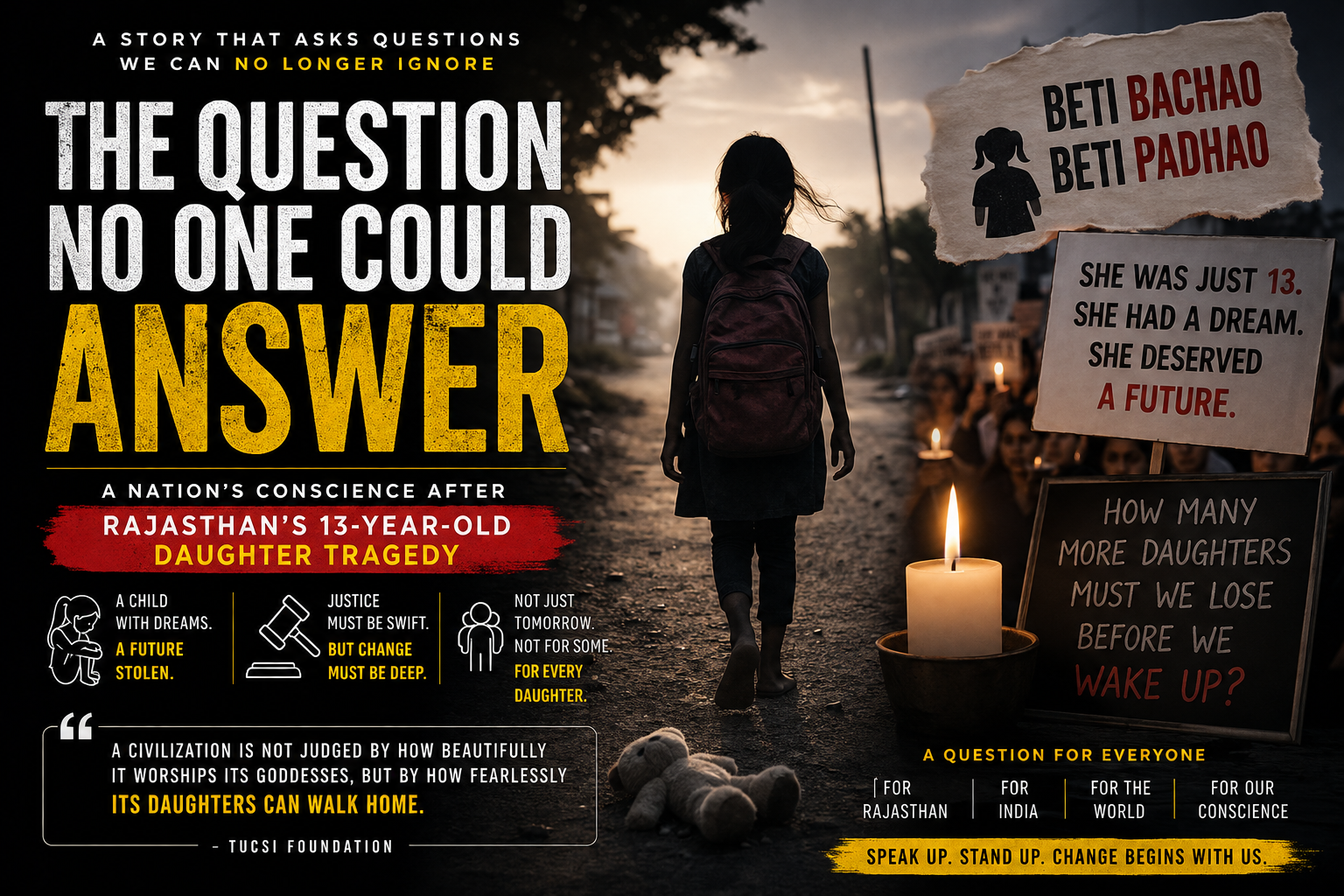
The Uncommon Story: The Question No One Could Answer . Written By Rahat Ali
This morning, somewhere in Rajasthan, the sun rose just as it always does. Birds sang, schools opened their gates, parents rushed to work, children carried their bags, and life appeared ordinary. But there was one home where time had stopped. A room still carried the fragrance of childhood. A school notebook lay open, waiting for homework that would never be completed. A pair of slippers rested quietly near the door, as though their owner would return at any moment. But she never would. She was only thirteen years old.The television called it breaking news. Newspapers called it another crime. Social media filled with hashtags demanding justice. Politicians issued statements. Cameras arrived, microphones were raised, and debates began. Yet, when the cameras left and the headlines changed, one question remained standing in silence: How did we fail a child?She had dreams like every other daughter. She wanted to laugh without fear, walk without looking over her shoulder, return home without making a phone call every few minutes, and believe that the world outside her home was as safe as the love she received inside it. Those dreams were not extraordinary. They were the smallest rights promised by every civilized society. Yet even those were taken away.We often say India is the land of culture, traditions, values, and spirituality. We proudly tell the world that our civilization teaches respect for women. Every year, millions of homes celebrate Navratri. We decorate temples, light lamps, sing hymns, and bow before Goddess Durga. We invite little girls into our homes, wash their feet, offer them food, and call them the living form of the Divine Mother. But when those same daughters step outside our doors, do we protect them with the same devotion with which we worship them?Perhaps the question is not for Rajasthan alone. Perhaps it is for every state, every city, every village, every institution, every family, and every one of us. What kind of society celebrates daughters in prayer but fails them in reality? What kind of culture teaches rituals perfectly but forgets humanity? What kind of education produces successful professionals but not responsible human beings?Somewhere tonight, a mother will hug her daughter a little tighter after watching this news. Somewhere, a father will wait anxiously until his child returns home. Somewhere, another little girl will quietly ask her parents, “Am I safe?” And perhaps that is the most heartbreaking question any nation should ever have to answer.Justice will come through the courts. Investigations will continue. Laws will take their course. Those responsible must face the strongest punishment permitted by law. But even the strictest punishment cannot return a stolen childhood. Justice punishes the guilty. It does not heal every wound left behind.The truth is uncomfortable. Crimes like these are not born in a single day. They grow where silence is accepted, where disrespect is ignored, where women are objectified, where children are not believed, where bystanders look away, and where society mistakes outrage on social media for lasting change. Every time we excuse harassment as “boys being boys,” every time we blame victims instead of offenders, every time we remain silent when someone crosses a boundary, we allow another brick to be laid in the wall that traps our daughters.Imagine, for a moment, standing before the Almighty—whether you call Him Bhagwan, Allah, Waheguru, Jesus Christ, or by any other sacred name. Imagine being asked only one question: “I entrusted My daughters to your world. What did you do to protect them?” Would we answer with speeches? Would we answer with festivals? Would we answer with promises? Or would our silence reveal the truth?This story is not about one child alone. It is about every daughter who deserves to dream without fear. It is about every parent who deserves peace instead of anxiety. It is about every boy who must be taught that respect is the first lesson of manhood. It is about every teacher who shapes young minds, every religious leader who speaks of compassion, every police officer who protects the vulnerable, every judge who delivers justice, every journalist who tells the truth, and every citizen who decides whether to remain silent or stand up.The measure of a nation is not the height of its buildings, the strength of its economy, or the number of its festivals. The measure of a nation is whether a thirteen-year-old girl can walk through it safely. Until every daughter can do so without fear, our work as a society remains unfinished.Tonight, before going to sleep, ask yourself one question—not as a Hindu, Muslim, Sikh, Christian, or follower of any faith; not as an Indian or a citizen of any other country; but simply as a human being: If she had been my daughter, what kind of world would I have wanted for her? Then spend your life helping build that world for every child.Because every daughter belongs not only to her family, but to the conscience of humanity.”A society does not lose its humanity in a single day. It loses it every time a child’s cry goes unheard. It regains it only when every child can live without fear.”— The Uncommon Stories of India (TUCSI Foundation)


Add comment